
‧₊˚✧ GenerativeAI Afterlives ✧˚₊‧

A few of the poems from Rival Streamer have been circulating in online spaces over the past few weeks — namely Instagram and X — and have even inspired some conversation regarding what they mean. I’d also like to direct readers to the comment section on this recent post, where you can find some interesting and valuable thoughts on the question of ‘what makes a culture’.
Beyond this, I’d like to add that I know successful poetry generates exterior interpretation, so I’m not too interested in setting the record straight when it comes to a collection of poems whose interpretation will be completely out of my hands in a week or so’s time. I don’t really know why I wrote “setting the record straight,” because most of the interpretations around the poems have tapped into my creative intention for the forthcoming collection.
That said, I cheated a little bit in the comments section at the beginning of the month, discussing the poem Angel Statue in terms of Silent Hill. I think Bram’s quote for Rival Streamer also tangentially approached this as a subject of inspiration when he mentioned “lonely PlayStation sessions.”
I’ve always wanted to write an anthropological study exploring the relationship between loneliness and video games. If there’s an institution out there that would like to fund this study, then get in touch — especially considering data released by the Office for National Statistics, which suggests that loneliness disproportionately affects younger Britons, with a third of 16–29-year-olds reporting feeling lonely at least some of the time, almost double the rate recorded among those over 70. I suppose the closest I came to achieving any kind of “study” of a video game was when I wrote about Genshin Impact for Baudrillard Now.
It is perhaps surprising to hear that I still consider Genshin Impact to be a magnum opus of video games — the video game equivalent of a 1000-page book by Tolstoy, or something like that. It is a polemic opinion I seldom share with others, and yet I find it to be a game that says something about the hyperculture in which it was written, as opposed to a game like Cyberpunk 2077, which concerns a culture that has — in many ways — been and gone.
Between juggling new responsibilities alongside writing essays and Substack posts, I don’t have time to visit Teyvat these days — and I’m not sure I could, even if I wanted to — but I suspect I could write more about my experience with Genshin Impact, given the opportunity. Do readers even want this? Perhaps I’ll have the chance to revisit this world for an upcoming seminar I’ll be attending by Conrad Hamilton, Video Games: Between Contagion and Reality. Of course, my experience with “lonely PlayStation sessions” goes further back than this, and I’d likely return to the PlayStation 2 if I wanted to write nostalgically about loneliness and video games. There is also the matter of the PSP, which is perhaps the cooler option when it comes to writing about the resurgent popularity of physical media — and the reappearance of the Y2K aesthetic more broadly.
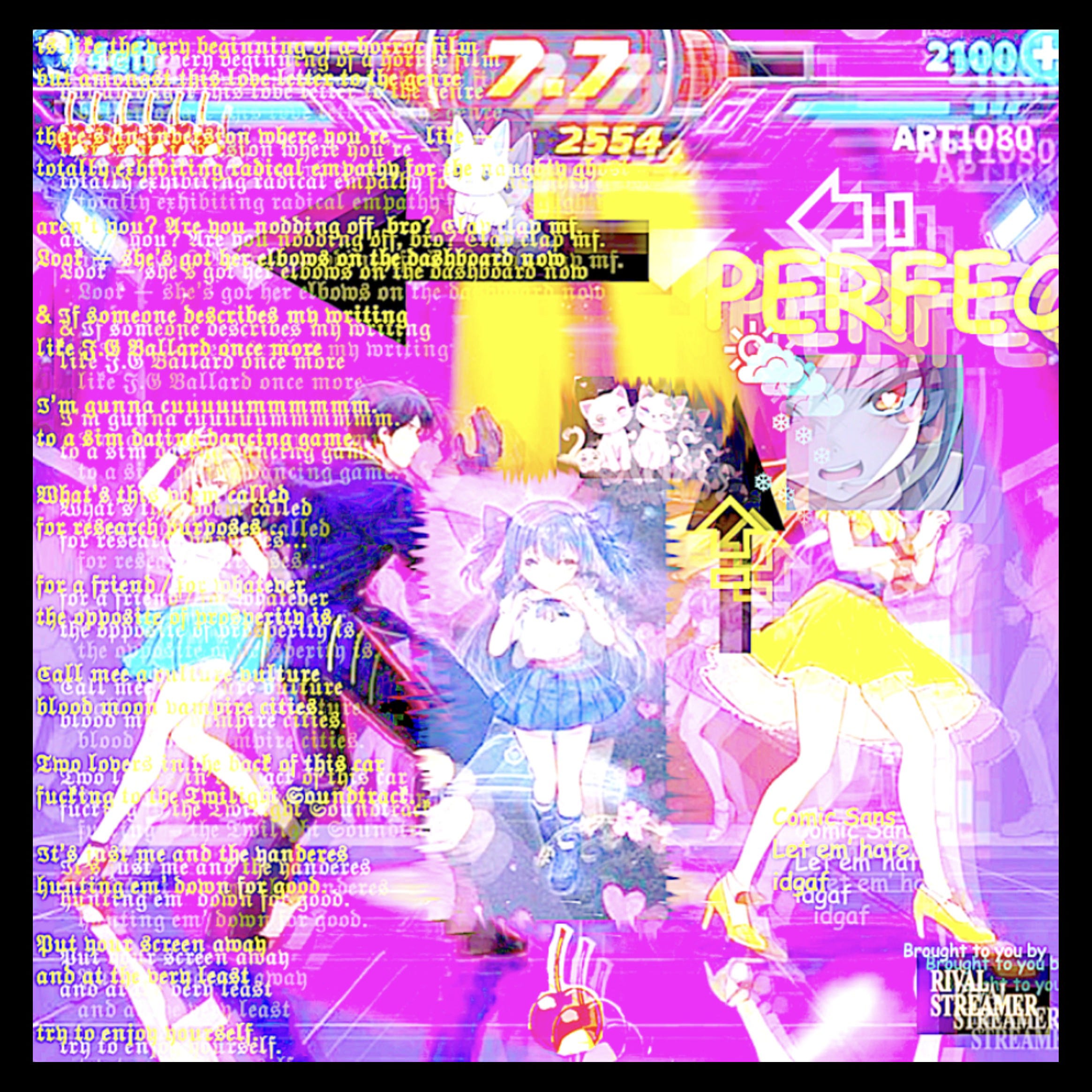
This is all to say that “lonely PlayStation sessions” are an important cultural touchstone for Rival Streamer, a visual poetry collection that sits adjacent to anime and video game worlds that are — according to many — under threat from the growing ubiquity of generative artificial intelligence.
It may be the case that generative artificial intelligence brings a certain type of video game industry to an end, which is interesting if you like to think about cultures in terms of their historical markers. It may also be the case that the use of artificial intelligence in creative industries will bring about a retrospective examination of pre-AI creativity, re-casting this cultural production in a way that is less concerned with production per se, and more concerned with appreciation. You already see this in video game subcultures that appreciate pre-rendered 3D backgrounds, and I now wonder if we’ll see this on a greater scale with art and culture that came about before “AI slop” allegedly ruined creative industries. We may come to appreciate — in new ways — the things human beings made before the arrival of generative artificial intelligence. Seen this way, we might even have to enter a kind of GenerativeAI Afterlife.
I think my interview with Alessia Vadacca — also published in Rival Streamer — arrives at a cursory answer to some of these issues around generative AI; but for this post, I was attempting to address those interpretations of my poems that have absolutely nothing to do with artificial intelligence and more to do with “lonely PlayStation sessions”. I have perhaps failed with this and have ended up writing about GenAI anyway.
I’d also add here that I had no say in which poems Trickhouse Press decided to release to potential readers as a way of whetting their appetites for this collection, so when I saw which poems had been offered on their website, I became weirdly fascinated by why those poems were chosen in particular. I suspect they were chosen because they offer a good overview of what people can expect to find in Rival Streamer but this hasn’t stopped me from descending into the kind of navel-gazing speculation I enjoy running through my mind.
As perhaps already mentioned, two of these poems — which I’ve since come to name, in passing, as “the bedroom poems” — were previously published on this Substack at the beginning of the month. I hope readers will permit me coming up with a collective name for these poems, which I’ve come to think about in terms of capturing what I’ve previously called the anthropology of the ‘Bedroomed Lifeworld’.
As such, it could be said that Rival Streamer concerns a miscibility of themes and genres, and I now wonder whether my dislike of Friedrich Hölderlin came about as a result of him coming too close to the familiar, liminal territory that lies between poetry and philosophy. Perhaps, at some subconscious level, I suddenly had to contend with the idea that there was someone out there who wasn’t so dissimilar to me — and yes — that sentence is about comparing myself to Friedrich Hölderlin… I’m sorry. Don’t get confused, though, because this is not about saying that I’m as important to history as Friedrich Hölderlin; rather, it’s about capturing the idea that both mine and Hölderlin’s worldbuilding concern the liminal space that lies between some semblance of established reality and somewhere else.
Seen this way, we could say Rival Streamer is about the creative space that still exists — perhaps only momentarily — between human beings and artificial intelligence. It is for this reason that I think Rival Streamer is an important book to have written, and the fact that The AI Literary Review has since discontinued tells me that this was the kind of book that had to be written at a very particular moment in history — a time when terms like “AI slop” and “brainrot” occupied unstable — dare I say, liminal — positions in the cultural imaginary.
I think a lot of my writing, whether it’s important to the world or otherwise, has been about capturing this sense of liminality, which comes across most viscerally in the hybridity of genre that plagues my work. I say “plagues” because writing that is difficult to categorise is difficult to publish; difficult to sell, both figuratively and literally. It is only through publishers who have taken a chance on me that I’ve been able to publish work in a traditional way that reaches readers and creates value.
As I now find myself writing a more standard “theory” book — a sequence of essays — I worry that this, too, will walk the line between philosophy and an alternative epistemology that will no doubt be looked upon with suspicion. I’m tempted to write, “I have come too early,” but the real irony of Friedrich Nietzsche is that he arrived when the world needed him. Since I’ve now written about myself in the same context as both Hölderlin and Nietzsche, I’ll see myself out… but first, I’d like to share something from Rick Roderick’s lecture Nietzsche as Artist:
“We are in what Gramsci called “An interregnum” about which he used as a word to describe periods in history where things are changing rapidly and people don’t know what’s going on exactly. And I think that’s the kind of period we are in now.”
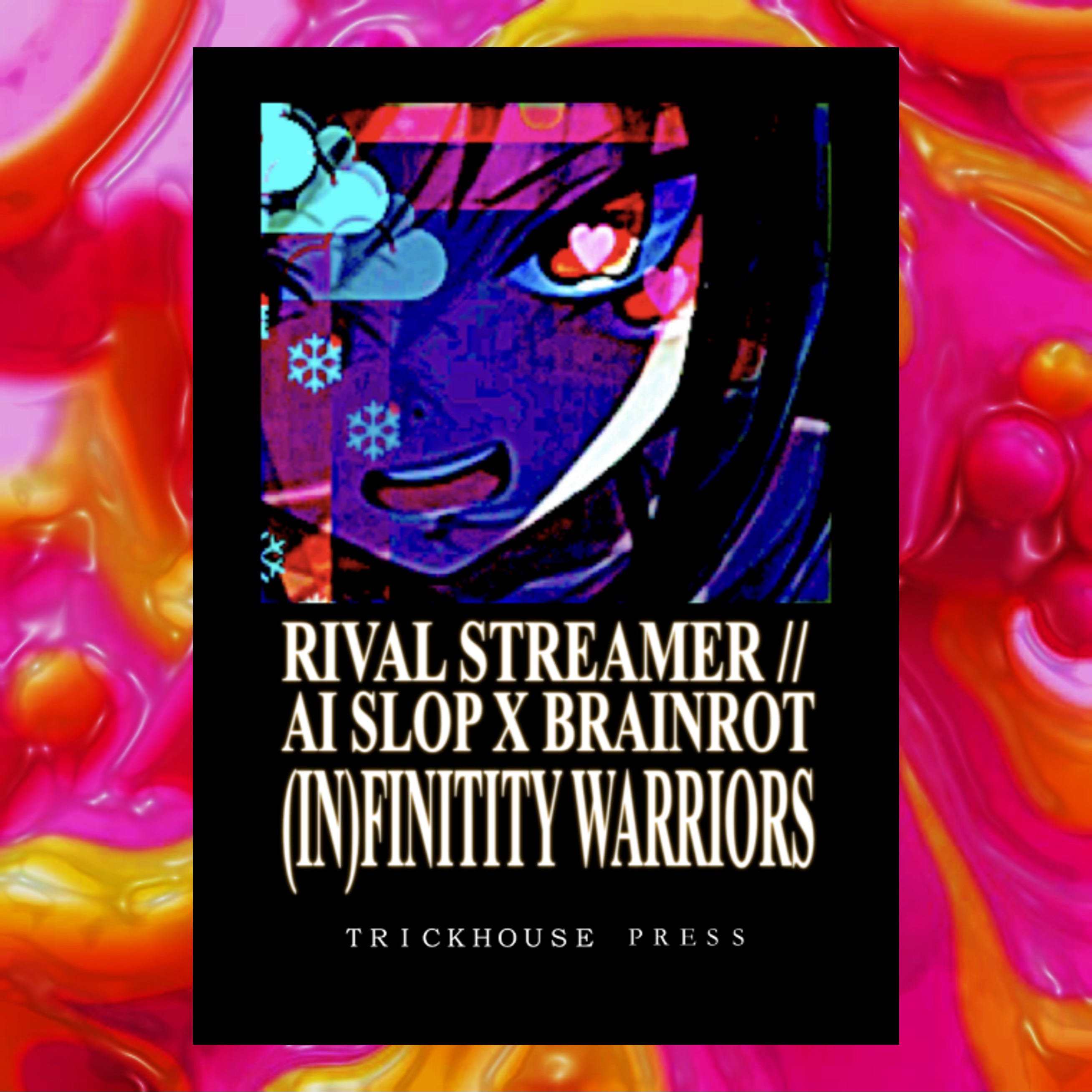
⁺‧₊✧ RIVAL STREAMER // AI SLOP X BRAINROT (IN)FINITITY WARRIORS can be purchased direct from Trickhouse Press ✧°⊹˚
“A glitchy aesthetic experience, a full descent to the surreal edges of our meta memetic present. Mazey is a collector of uncanniness, a lyricist of today’s algorithmic hyperreality” — Alessia Vadacca
“A blistering blast of high-concept cyberpunk verse paired with chopped and screwed visuals, filtered through hauntological artificial intelligence systems. RIVAL STREAMER is artfully littered with allusions to immersive RPGs, lonely PlayStation sessions, liminal dreamscapes, glitching Twitch streams, science fiction tropes from Philip K. Dick and J.G. Ballard, and the disaffected raps of $uicideboy$, Lil Peep and Drain Gang. Alex Mazey isn’t just a poet or a theorist, he’s a Baudrillardian chronicler of our hyperreal life and times - a William Gibson of poetry and ideas, conjuring spectral visions of the dystopian present.” — Bram E. Gieben
“glitchpunk imminence / temporal ruptures / I am interested in talking to the future / imposed warp affronting AOE tectonics / lemurian activism / imminence after the future is waste / baudrillard after the orgy / (title in alphanumeric quabbalah emerges creation from entropy before anthropomorphisation re: numogram / also 88 pages so...) / consider if #cuteacc “emancipate image” production perpetuate it self not u / what it is / will be to “truly live” digitally / that is how the city may come to be defined / AI alarmism focusses on conscious machines but mazey’s text accounts for unconscious humans / that we might eventually just switch off to merge / dear peter thiel / alex is ur rival streamer” — Richard Capener
Alex Mazey’s RIVAL STREAMER // AI SLOP X BRAINROT (IN)FINITITY WARRIORS is a re-calibration of literary sincerity and authenticity for a post-AI world, and a defiant cry of humanity distorted through today’s ever-tightening digital mesh. This collection consists of strikingly original visual poems, which navigate deftly through the disturbing and the absurd, and an interview between the poet and Alessia Vadacca, originally published in CyberPoeticZine.
Thanks for writing this, it clarifies a lot; your point on games and loneliness realy resonates, I've seen that connection myself.
So much 🤯 and always worth the mental wading. Bless you.